The hidden financial cost of employees working when they shouldn’t.
Whilst you might be glad that official sickness rates in your organisation are low, the picture you receive from HR not as clear as you think. Recent data shows that 59% of employees don’t take time off when they’re sick, despite needing to.
This means that they’re heading into the workplace unwell and whilst they may technically be there physically, its highly likely that they aren’t fully there mentally.
We all know that feeling unwell can be challenging, and to head into work in those circumstances means that tasks which were once easy can become difficult and time-consuming. Staff who are unwell aren’t being as productive as you may think, nor are they producing high quality, focussed work.
The cost of presenteeism in the workplace is rising. Prior to the pandemic, the effects of presenteeism was losing the UK economy £20bn - this has since increased to £27bn. The CIPD has seen presenteeism tripling over the past ten years, but many employers are still not taking action to prevent it.
Why do employees continue to come to work when they’re sick?
The following may help explain:
Many employees believe that nobody would believe that they're really sick (19%), they feel guilty that their colleagues might have to pick up some extra work, or they feel concerned about their boss' reaction (17%). (HR Grapevine)
There continues to be a stigma attached to calling in sick for work, and workplace culture can be less understanding or caring than many would hope. We know that there’s unfortunately a lot of stigma surrounding mental health and sickness for this reason, but there’s also a general sense of judgement for employees calling in sick - irrespective of their circumstances.
Why is presenteeism a problem for employers?
Presenteeism has a big impact on productivity and the quality of work that is produced. Even though employees are physically present, tasks become more challenging when they’re unwell and they can be distracted by their symptoms.
Presenteeism hampers recovery, and the cycle of reduced peformance due to illness continues. It's preferable - and less costly - for businesses to have a well-considered occupational health policy in place, affording employees the opportunity to return to good health before returning to work.
Employees should be able to receive the correct support for both short-term illness and longer-term health conditions. Nobody should feel like they’re pushed to breaking point, or feel burnt-out, as that’s worse in the long run.
Investing in exceptional occupational health support and adopting a healthier and more understanding culture in the workplace is proven to make employees feel more valued and reduce presenteeism / absenteeism.
What is Employee Presenteeism?
There are several definitions:
- Being present whilst at work - but having underlying health conditions, thus not being fully functional.
- Working long hours - but not being present and leading employers to believe they are performing.
- Working at a decreased level - due to a range of social/economic distractions.
At UKIM Occupational Health and Wellbeing, we know the importance of maintaining optimal mental health in the workplace. Our occupational health case managers, mental health interventions and training programmes can help you to foster a healthy working environment.
Our approach to reducing presenteeism
We look at the physical, psychological and sociological factors that presenteeism has on your workforce - such as mental health issues, childcare issues, caring responsibilities and illness.
Our biopsychosocial model below demonstrates how, with our holistic approach, we set out a clearly defined pathway to prevent, assess and treat employees to ensure a fit, happy and productive workforce.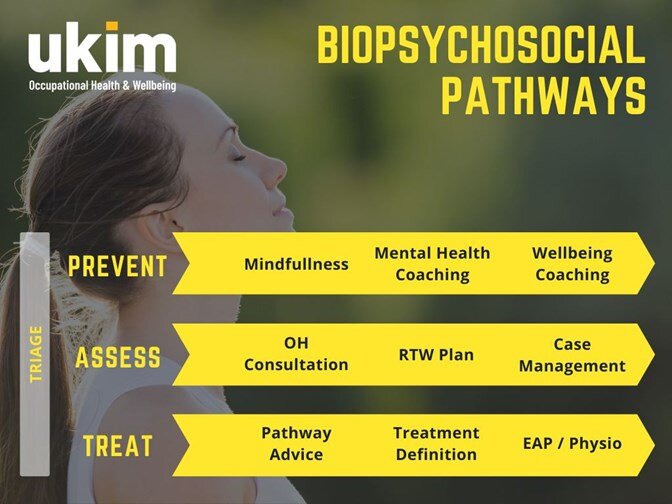
Our consultative approach means that you will receive a service entirely designed to support your business and employee wellbeing.
Want more Occupational Health insights to help your business? You may also like to read...
- NHS waitlist set to reach over 8 million by mid 2024 - can Occupational Health Services help?
- UKIM Awarded Place on ESPO Framework for Occupational Health and Employee Assistance Programme Services.
- Enhancing Employee Retention and Recruitment: The Role of Occupational Health Services.
- Respiratory Health in the Workplace: The Importance of Occupational Health Services
- What are the legal requirements and regulations related to Occupational Health and Safety?
- How do Occupational Health services support employer duty of care?
- How Investing in Occupational Health Services can lead to greater ROI
- Occupational Health Referrals for Employees and how to make them.